A founder we talked to had a solid product, decent traffic, and a Google ranking he was proud of. Then he asked ChatGPT the exact question his best customers ask before they buy. His product wasn't in the answer. Three competitors were, including two he'd never lost a head-to-head demo against.
That's the uncomfortable part of AI search: it doesn't tell you when you've been left out. There's no notification, no ranking report, no dip in a dashboard. You just quietly stop showing up in a conversation you didn't know was happening.

Why ranking on Google isn't enough anymore
Traditional SEO optimizes for a results page: ten blue links, a searcher scanning and clicking. Generative Engine Optimization (GEO) optimizes for something different: a single synthesized answer, assembled from whatever sources the model trusts enough to cite. You can rank on page one for your category and still be completely absent from the one sentence a buyer actually reads.
This matters more the earlier you are. An established brand has years of mentions, reviews, and backlinks baked into the model's training and retrieval sources. An early-stage SaaS usually has almost none of that, which means the gap between "ranks fine on Google" and "gets recommended by AI" is often much wider than founders expect.
What "GEO" actually means, in plain language
Generative Engine Optimization is the practice of making your product easy for an AI model to find, understand, and confidently repeat. Confidently is the key word. Models tend to cite sources that state facts clearly and consistently, not sources that bury the point in marketing language. If a model can't quickly answer "what does this product do, for whom, and why," it will usually just leave you out rather than guess.
The 4-step way to check if AI engines know you exist
- Ask the exact question a buyer would ask, in their words, not your marketing copy's words.
- Note who gets named, in what order, and whether you're mentioned at all.
- Search your own brand name directly and see if the model describes you accurately.
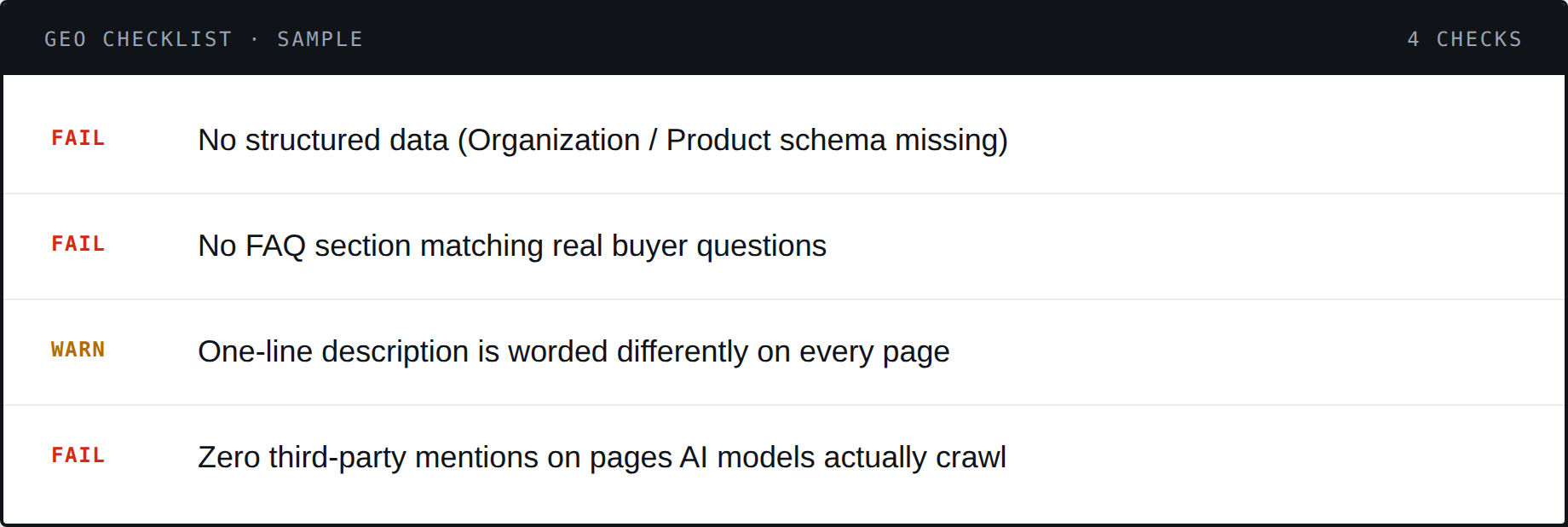
- Check whether your site gives a model anything easy to cite: structured data, a clear one-line description, an FAQ that mirrors real questions.
Ask it the way a buyer would, not the way you'd Google it
This step trips people up the most. Founders test with their own brand name, get a reasonable answer, and conclude they're fine. That's not the test that matters. The test that matters is the category question a stranger asks when they don't know your name yet: "what's a good tool for X," "alternatives to Y," "how do I fix Z." That's where you either show up or you don't.
What to fix once you know you're invisible
None of this requires waiting on Google. Most of it is within your control this week:
- Add structured data. Organization and Product schema give a model an unambiguous, machine-readable fact sheet instead of forcing it to guess from prose.
- Write one description and repeat it exactly. If your homepage, your About page, and your app store listing each describe you differently, you're making the model do extra work to reconcile them, and it usually won't bother.
- Get mentioned on pages models actually crawl. Comparison posts, directories, and community threads carry more weight here than another blog post on your own domain.
- Add an FAQ section that mirrors real buyer questions. Not "what makes us different" written by marketing, but the literal phrasing a confused prospect types into a search box.
- Keep the facts consistent everywhere. Pricing, category, and positioning that shift from page to page read as noise to a model trying to cite you confidently.
Where this fits in GrowJin
We put GEO at Stage 05, not Stage 1, on purpose. Checking your AI visibility before your foundation, website, and SEO basics are solid just tells you the same thing this article did: you're invisible, with no context for why. Fix the fundamentals first, then find out exactly where you stand with AI engines.
Check my AI visibility →What to do now
Open ChatGPT or Perplexity right now and ask the question your best customer asked before they found you. Not your brand name, the category question. If you're not in the answer, you now know something your traffic numbers and Google rankings were never going to tell you. The fixes above are the same ones we run as part of GrowJin's GEO Audit, in the same order, against your actual site.